From Large Backgrounds to Reusable Terrain Tiles
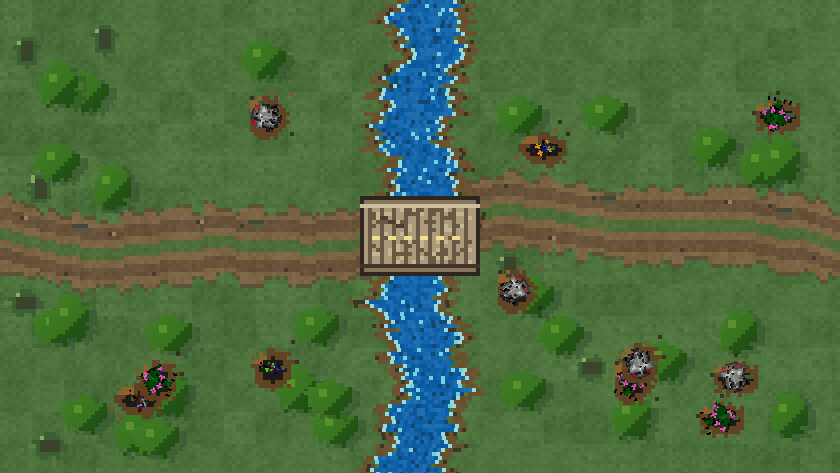
Today I experimented with a new terrain pipeline for Cloudstrike. The goal is to reduce memory usage without losing the game’s pixel-art identity. Instead of keeping large procedural background images in memory, the terrain can be assembled from small seamless tiles and compact decoration layers. The transition was iterative. The first version looked too much like a football field, so I tightened the grass palette. The road was too smooth, so I regenerated it at 210×120 pixels and scaled it with nearest-neighbor filtering to create a stronger pixel look. After that I added trees, craters, rivers, bridges and crashed aircraft. The wrecks use the current enemy and player generators, maximum damage variants, small rotations, impact craters and collision-free placement. The GIF shows the intermediate stages. Clouds are intentionally disabled so the terrain structure remains visible. The same approach should work for grassland, sand, mud and snow. The desert uses no trees, while mud and snow use their own palettes and vegetation rules. The next step is integrating this prototype into the actual scrolling terrain engine and measuring the final memory reduction!
Discussion