How Shroomingz Grew from Grey Dots into a Living Root World
The first version of Shroomingz worked, but it did not feel alive yet.
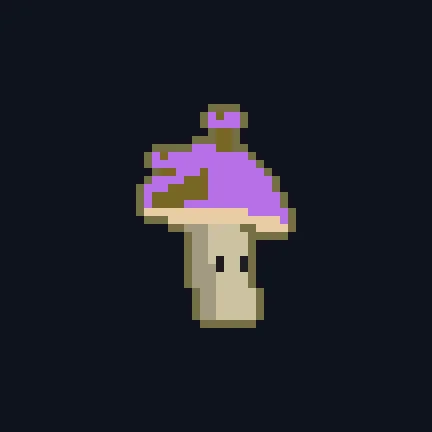
Six tiny mushroom creatures walked through a portrait puzzle level. I could place a spore cloud to protect them from a deadly fall. The rules were there. The world behind them was mostly a dark background with static grey dots.
Over the last few days, that prototype turned into something much closer to the game I had in mind.
The tutorial was clear to me, but not to players
The most useful feedback was also the least comfortable: people did not understand the tutorials.
The abilities were visible, but their purpose and placement were too easy to miss. I rebuilt the opening around large named ability cards, strongly marked placement areas and pauses that give players time to act.
The first lesson still plays a small joke. It encourages the player to use fall protection on a harmless step. Shortly before the real drop, the game admits that spore powers have a cooldown. On retries, the joke gets out of the way and lets the player solve the level normally.
The second lesson teaches turning before a salt wall. The third is a deliberately gentle helicopter tutorial with a wide landing platform and no time pressure.
This was a good reminder that a tutorial is not finished when the information exists. It is finished when a new player notices it at the right moment.
Turning the background into part of the mood
The visual work began with the roots.
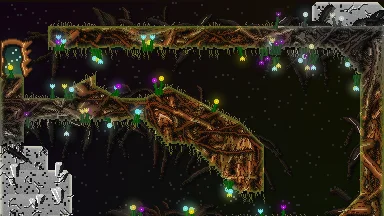
Instead of drawing a fixed texture, the game now grows several deterministic root passes through the solid level shape. Roots curve, branch, overlap and occasionally break out of the wall. Each pass receives a dark outline, layered body colors, an irregular highlight and a small shadow cast onto older roots.
Then came bark marks, chipped highlights, scattered dots and a four-color camouflage mask. The mask changes between root passes, so the forest looks patched and organic rather than covered by one repeated texture.
The old grey background dots became drifting dust. Every particle falls slowly, sways sideways and wraps back to the top. Nearby flowers tint individual grains. Every visible particle in a spore cloud is also its own small light source, so the colored influence disappears one particle at a time as the cloud dissolves.
Wind fields now catch and illuminate dust instead of looking like a technical overlay. They also spawn a few green grains at their intake edge, which keeps lower wind tunnels visibly active.
Salt needed structure, not just white pixels
Salt is the danger that is pushing the Shroomingz out of their forest, so it needed its own visual identity.
The current salt surface desaturates its surroundings without adding a pixelation filter. Its corners break away, exposed edges catch light, and veins and facet marks run across the crust.
Inside those salt areas, small crystal prisms now grow from random seed points. Each crystal is built from three quadrilateral faces and a hexagonal cap: a bright left face, a neutral center, a shadowed right face and a faceted top. A darker edge is offset to the right to cast a tiny shadow back onto the salt.
The crystal count, placement chance, length, width, tilt and palette can all be tuned in the scenery editor. The same editor controls the roots, bark, camouflage, flowers, lighting and the four-corner background gradient.
A campaign is starting to form
Shroomingz now has three tutorial levels and nine campaign levels. The campaign begins with simple one-cloud problems and gradually introduces combinations. Three difficult final levels use narrow cloud zones and short timing windows for the second and third abilities.
The levels now connect into a small journey away from the salt-struck forest and toward Moss Hollow. Short lines before, after and following failed attempts keep that story moving without stopping the puzzle for long.
The next major step is adding two more abilities that create new kinds of decisions instead of repeating the three existing powers.
Discussion