Spectral Beam Readability Update
Date: September 1, 2026
Build: 0.3.9
Focus: Beam color clarity and overlapping light paths
The problem
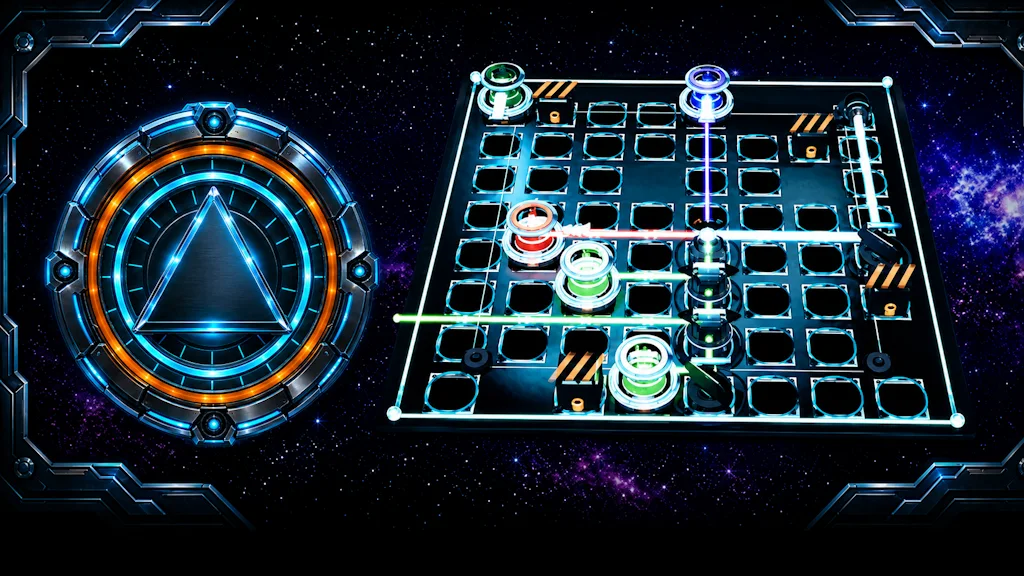
During testing, red, green, blue, and white beams became difficult to distinguish when multiple beams traveled across the same section of the board.
The beams were being rendered directly on top of one another. Because they use bright additive lighting, overlapping colors combined into an almost completely white line. Increasing color saturation alone could not solve the problem: once several bright beams occupied the exact same path, their light still blended together and hid the individual colors.
This was especially confusing on advanced boards where identifying each beam’s color and following its complete route is an essential part of the puzzle.
The solution
Overlapping beams are now arranged into narrow, parallel spectral lanes.
When multiple colors travel across the same edge of the board, each color receives its own visible lane. This allows the player to follow the red, green, blue, and white paths independently without changing how the underlying optical simulation works.
A beam traveling by itself remains centered in the cell exactly as it was before. The lane separation is only applied where two or more beam paths overlap.
The lane order is deterministic, so the same beam does not jump randomly from one side of the path to the other while the board updates. Beams traveling in opposite directions across the same edge also use the same stable lane system.
Visual improvements
The beam palette was refined to make every color easier to identify:
- Red beams now use a deeper, more saturated red.
- Green beams now use a cleaner green with less white contamination.
- Blue beams now use a stronger, more recognizable blue.
- White beams remain neutral white.
- Colored beam cores no longer receive the shader’s previous white tint.
- Colored impact lights preserve the color of the beam instead of washing toward white.
- Excessive halo brightness was reduced to prevent bright colors from clipping into white.
- Shared-path brightness is balanced automatically so several overlapping beams do not become brighter than the rest of the board.
The beams remain continuous, smooth, and premium-looking. No dashed lines, beads, gaps, pulsing blocks, or segmented patterns were introduced.
Gameplay integrity
This update changes presentation only.
It does not alter:
- Beam simulation
- Beam direction
- Optical component behavior
- Board layouts
- Receivers or emitters
- Component inventories
- Existing solutions
- Move counting
- PAR values
- Campaign progression
- Daily board generation
- Save data
A board that was solvable before this update remains solvable in exactly the same way. The difference is that the player can now clearly see which colored beam is following each route.
Accessibility and readability
The new rendering system improves normal color recognition without relying solely on brightness. Separating coincident colors spatially gives the player an additional visual cue, which is particularly useful on complex boards containing several active beams.
The existing color-blind beam-pattern option remains available and is not replaced by this change. The lane system works alongside the game’s current accessibility settings.
Technical implementation
The beam renderer now examines the visible one-cell beam segments before displaying them. Segments that share the same physical board edge are grouped together, including segments traveling in opposite directions.
Each grouped segment receives a stable lane index and a small perpendicular offset. The amount of separation scales slightly with the player’s selected beam-width setting so the beams remain distinct without becoming disconnected from the devices carrying them.
Overlapping glow energy is normalized across the group. This prevents two, three, or four nearby beams from producing a disproportionately bright bloom while preserving the luminous appearance of a single beam.
The beam shader was also adjusted so colored cores retain their original chroma instead of blending toward white.
Regression protection
Automated checks were added for the new behavior:
- Coincident beam colors receive separate, symmetrical lanes.
- A beam with no overlapping route remains centered.
- Red, green, and blue beam materials remain dominated by their intended color channel.
- Lane placement is stable and deterministic.
- The visual separation does not modify the underlying beam route.
Discussion