The story arrives at level eighteen
Spoilers ahead
This post gives away the end of Chapter 1: what the game is really doing, and what happens on the last level. If you have not played that far yet, reading on will take the reveal away from you, and the reveal is the best thing in the chapter.
Go and play it first. It is free, and this will still be here.
Ok.. read on for spoliers...
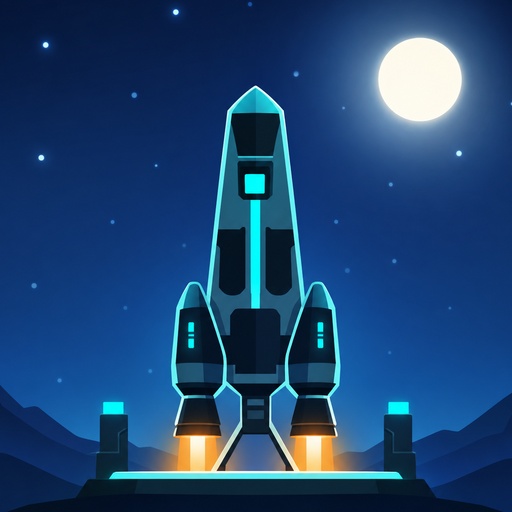
TwinThrust began as a physics game with no story in it whatsoever. Seventeen levels of landing a rocket, and no reason for any of it. The story turned up near the end of Chapter 1, and the useful part is that I did not have to go back and change a single earlier level to make it land.
Seventeen levels of nothing but flying
The teaching arc of Chapter 1 is purely mechanical. Controls, then open flight, then vertical gaps, a moving pad, an enclosed corridor, laser timing, a descent, darkness, timed gates, debris, a gravity well, a force lift, a maze, a switch and gate, random gusts, layered orbits, and a spiral. Seventeen levels, seventeen ideas, no plot.
I was happy with that and I would build it the same way again. But a game that is only a difficulty curve has a specific problem: it has no reason to have chapters. It just has more levels, and eventually the player asks what for.
The cheapest possible reframe
The answer I landed on costs almost nothing, and I think it is the most useful trick in the whole project.
The hazards were never random. They were a test, and you were being watched taking it.
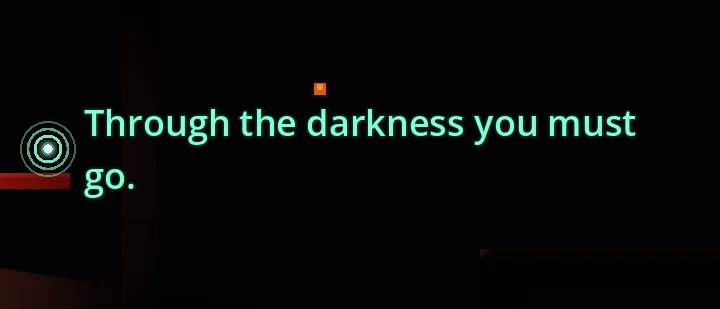
At level 18 a signal starts intruding on the HUD. At 19 the level presents itself as a trial grid and signs off with "Pilot performance: evaluated. Candidate status: pending." At 20 the thing doing the evaluating turns up, puts a beam through the roof, takes the craft, and says there is much work to be done.
What that does, retroactively, is turn seventeen levels of unexplained escalating hazards into an audition. The gravity well, the blackout, the storms, the orbital debris: those are the exact skills you would test for if you were recruiting somebody to fly into foreign worlds and bring something back. The player has already passed it. They just did not know it was scored.
I did not write a word of new fiction into levels 1 through 17. I reinterpreted them.
Why late is better than early here
Had I opened on the story, every one of those levels would have had to carry it. Level 3 is a lesson about vertical gaps. It is a good lesson. It would have been a worse one with a character talking over it.
Arriving late also means the story's first job is to answer a question the player already has, rather than to raise one they do not care about yet. By level 17 they have noticed the hazards are escalating past anything natural. The reveal is a payoff, not an introduction.
The cost is that you get exactly one shot at it, and it has to be a spectacle. Level 20 is the only level in the chapter that is more set-piece than test.
The story is a reward, not a hook
There is a harder truth underneath all of this, and I would rather say it plainly than pretend the design is cleverer than it is.
TwinThrust is a game of skill and patience. The tutorial says so in as many words, on a card of its own: speed is rarely the answer. That is an honest warning, and it also means the game is not going to be for everybody. I fully expect a good number of people to download it, spend four levels fighting the controls, decide it is not what they wanted, and never open it again. That is fine. I would rather make the thing I wanted to make than sand the edges off it until it is agreeable to everyone.
But that reframes what the story is for. It is not there to hook a new player, because a new player has not decided whether they like this yet, and no amount of plot will make an unwanted control scheme feel good.
The story is for the people who were already enjoying it. It is what they get for staying. If you reach the end of Chapter 1, you did not get there by accident. You wanted to be there. You learned a control scheme that is deliberately awkward at first, you worked through twenty levels of it, and somewhere in there the awkwardness turned into the point. Those are exactly the people worth giving a reason to carry on to.
So the reveal is aimed at them, and it is allowed to assume they are invested, because anybody who is not has already gone. Which is why it can afford to be a spectacle instead of an explanation: it does not have to sell the game to you. You already bought in, with your thumbs, over twenty levels.
The machinery, which is smaller than it sounds
All of this runs through one reused HUD label and a timeline. A level declares a list of beats against its own elapsed time, and the label renders them in one of two voices: an amber navigational style for your own instruments, and a corrupt cyan-green style, jittered, with the characters scrambled so they resolve toward clean text as the signal locks on.
That second style is doing a disproportionate amount of work. It says "something else is talking to you" before a single word is legible, which means the reveal is atmospheric for several levels before it is explicit.
Later chapters kept that system and added a second lane, because by then there are two parties talking and the player needs to know instantly which one this is. Colour carries it.
The rule I keep relearning
One rule has survived every chapter since, and I have broken it more than once and paid for it every time.
Text and control never live at the same time. If the player is flying, they are not reading. If they are reading, do not also ask them to fly. Every time a line of dialogue has landed while something dangerous was happening, the result is that the player either missed the line or died, and both of those are my fault rather than theirs.
The version of this I got wrong most recently was subtler. A later level lands, the screen says the landing is confirmed, the fireworks go off, and a character is still mid-sentence explaining what the chapter just cost. A screenful of celebration underneath somebody delivering bad news reads as a bug. The fix was to make the celebration wait for him to finish. The landing chime still plays on touchdown, because that is the craft confirming it is down, but the game does not applaud until the scene is over.
What I would tell anyone bolting a story onto a finished thing
Do not go back and add narration to content that was built without it. Find the reading of that content which makes it evidence for the story you want to tell, and then tell the story at the point where the player is most likely to have that same suspicion already.
It is cheaper, it is more respectful of levels that were doing fine on their own, and it makes the player feel like they worked it out rather than like they were told.
Discussion