

Trailer & screenshots
About this game
The game Conquest is a Risk-style strategy game for 2–5 generals, played on the news. The board is the week’s most-covered news cities. Each general starts with a capital and two provinces beside it, then raises soldiers, agents and technology to take more: fighting for them, winning neutral ones over with diplomats, and sabotaging, hacking and assassinating rivals. The news is the weather: provinces whose storylines are trending pay more, and each day’s real events (a storm, a cyberattack, a truce) become cards that change the odds. Every turn all the generals order at once, the orders resolve together, and every roll is provably fair.
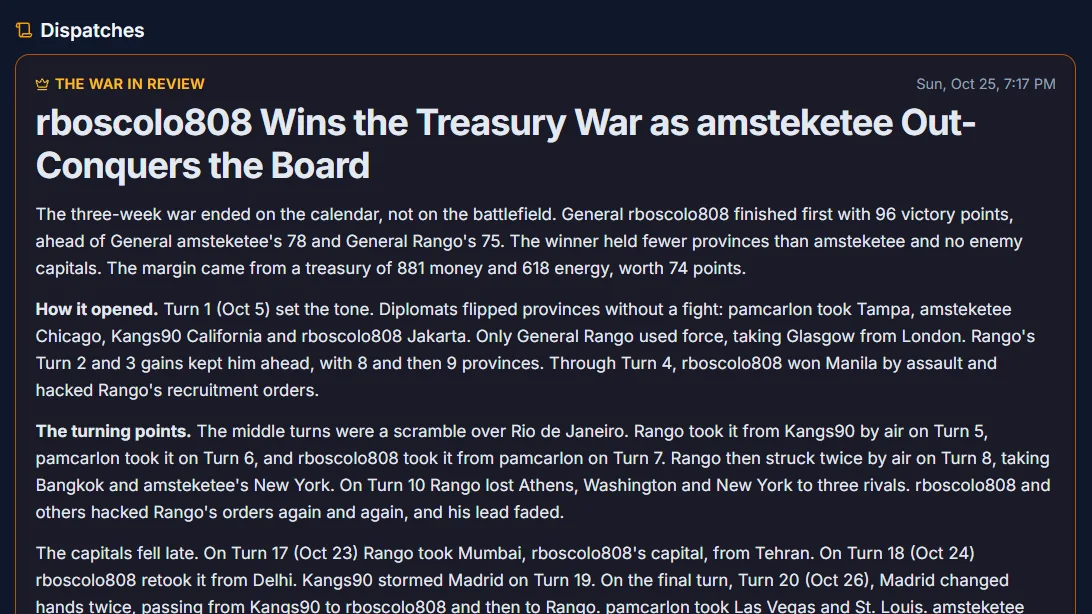
How you win Eliminate every rival for total conquest, or hold the most victory points when the war is scored (Friday night for a weekly war, the end of its weeks for an epic, its last turn for a blitz): 2 per province, 5 per enemy capital you hold, plus (money + energy) ÷ 20 at week-1 value — in later weeks the divisor grows with income (÷30 in week 2, ÷39 in week 3), so a hoard counts for what it would buy. Hoarding counts — but provinces count double. When the war ends, its dispatches open with the war in review: the whole war retold, and every general’s points with the arithmetic shown.
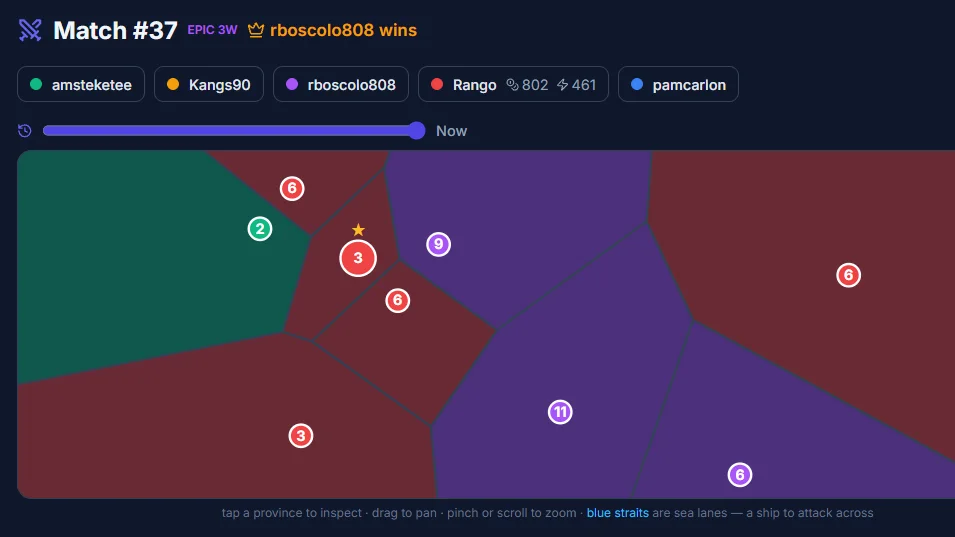
The map Every province is one of the week’s news cities, with its borders drawn around it; your match plays a connected slice of the week’s board, sized to the table. Provinces that share a border are neighbors: soldiers move and attack only between neighbors, except that a plane carries an attack two borders out (and a missile strikes up to three). A border longer than 2,500 km is a sea lane, one of the blue straits, and an attack across it needs a ship or a plane. Each province pays money and energy every turn, more when its city’s storyline is trending; select a province to see who holds it, its garrison and what it pays.
The board wraps east to west, like an old arcade map: the provinces on the far right border the ones on the far left, so no corner is a safe back wall. Drag the map any way you like — it never runs out — and it opens with you in the middle; center on me brings you back. Wars opened before the wrap arrived (late October 2026) keep the flat board and flat prices they began with.
Your start A capital (4 soldiers, 1 diplomat, 1 spy) plus two adjacent provinces (1 soldier each), 100 money and 40 energy. Lose all your provinces and you’re eliminated.
The week Every Saturday a new board is carved from the week’s most-covered news cities. A weekly match runs until Friday night’s final scoring — or until someone conquers everyone first. You can play in as many matches as you like; orders are per match.
The rhythm — weekly, epic or blitz Each turn you submit up to 5 orders in a war’s first week (more as the weeks pass — see Inflation), and submitting locks them in — no changes, and the table sees your checkmark. The moment every living general has reported, the turn resolves: all orders simultaneously, in fixed priority (world & local events → cyberattacks → assassinations → politick & sabotage → income → influence → build & buy → moves → missiles → attacks → outcome). Within a phase the seat holding the initiative acts first. Who holds it on turn 1 is drawn at random when the war starts, and it then rotates one seat around the table every turn, so no one keeps first strike. The ledger under each dispatch is laid out in exactly those phases, each header saying why it comes where it does. An eager table plays as many turns a day as it can. The dice come from a seed whose hash you can see before you order and whose value is revealed after — every roll is checkable.
A weekly match runs to Friday’s scoring (or ends early by total conquest), and each turn waits at most 24 hours: then it rolls without the generals who haven’t reported, who simply sit that turn out, so one absent general never freezes the war — and no table is rolled at midnight while half of it is asleep. A turn still waiting at Friday’s final never rolls; the war is scored as the map stands. An epic match runs for 1–4 weeks from launch — a long war lives through weeks of changing daily event cards, the news itself becoming its shifting weather — and has no clock: a turn rolls only when every living general is in, so a table spread across time zones plays every turn together. An absent general holds the table until they report or resign (or the general who opened the war calls it off), and when the weeks are up the war is scored as the map stands; a turn still waiting on someone never rolls. Having too much fun to stop? The general who opened a live weekly or epic war can extend it by 1–4 weeks from the match page (up to 12 weeks from launch). An extended weekly war becomes an epic, so from then on each turn waits for every general. A blitz match ignores the calendar and runs a chosen length — 7, 15 or 30 turns, or no limit, playing to total conquest — a whole campaign in one sitting. Same rules, same dice, same season credit.
The economy — news is the weather Each province you own pays its base money and energy every turn (select a province to see its rates), multiplied by its storyline’s heat today — a province whose news is trending pays up to ×2, a cold one pays base. Politicking adds ×1.5. Three daily event cards, drawn from real stories, shift the whole world: yield multipliers (×0.5–1.5), attack or defense die bonuses, doubled diplomacy, or — on a day a real cyberattack or an AI breaking out of its sandbox makes the news — doubled cyberattacks, so one breaches; and on a day an assassination, an attempt on someone’s life or a plot to kill makes the news, doubled assassinations, so one attempt kills.
On top of the global cards, LOCAL EVENTS strike individual provinces, drawn from that city’s own news: a wildfire cuts a province’s energy output, unrest costs its garrison a soldier, a fortification boosts its defenders, a storm wrecks an asset. They apply to that province only — whoever holds it — and they follow the news: when the wildfire ends or the truce is signed, the effect stops appearing. Dice and income effects hold all day; unit and asset changes happen once per day. The ledger names every one. Unrest can take a province’s last soldier: the province stays yours and keeps paying, but it stands empty — any attack takes it without a fight — until you move soldiers back in. The board marks an empty holding with a hollow 0.
The cards and the heat are the day’s weather, not the turn’s — real news doesn’t change by the hour, so every turn you play in a day fights under the same conditions. A fast table campaigns through one day’s world; a slow one watches it shift under their feet.
Inflation — every week dearer, and bigger Every seven turns is a week of the war — turns 1–7 are week 1, 8–14 week 2 — in every kind of war, whatever its pace: a table that plays three turns a day is in week 2 on its third day, one that plays a turn a day on its eighth. Each new week the routine gets dearer: soldiers cost 5, then 8, then 11, then 13 and 15. Cheap things follow prices fully; dear ones climb slower (a tank goes 40 → 55 → 65, a rocket 100 → 121 → 136), so tech gets relatively cheaper as a war grows old. The limits grow with them, and income too:
Week (turns) Soldier Recruits an order Orders a turn Income 1 (1–7) 5 / 2 5 5 ×1 2 (8–14) 8 / 3 9 7 ×1.52 3 (15–21) 11 / 4 13 9 ×1.93 4 (22–28) 13 / 5 16 10 ×2.3 5 (29–35) 15 / 6 20 11 ×2.63 Orders top out at 12 a turn from week 6, recruits at 30 an order. A turn keeps its week’s prices from the first order to the dice, and Marco tells the table talk when a new week opens. Income trails the price of soldiers on purpose: coin hoarded in week 1 buys less in week 3, so spend it while it is worth something. The order form always shows this week’s prices, and the strip above the board shows next week’s and the turn they arrive on.
Orders move — Shift soldiers between two adjacent provinces you own. One soldier always stays behind as garrison. Only soldiers move — every other unit stays where it was recruited.
attack — Send soldiers at an adjacent enemy or neutral province, or from a province with a plane at one up to two borders out. Sea lanes need a ship (or that plane). The assault rolls round after round until your column is spent or the last defender falls — then every survivor marches in.
missile — Fire a missile from a province holding one at any province not yours up to three borders away, land or sea alike, and name the asset to destroy (or leave it to hit the most valuable). Missiles land after the moves and before the attacks, so tonight’s assaults face what is left. A missile bought in the same night’s orders can fire that night.
influence — A diplomat in one of your provinces bordering the target pushes it — one push per diplomat per turn. Neutral provinces flip at 2 influence — two pushes, or one under a diplomacy event card.
spy — Sabotage an enemy or neutral province: tonight every attack staged from it rolls −1 on its top die, and its defenders roll −1 when attacked. One sabotage per spy per turn, from anywhere in your empire — mark the province you mean to hit, or the one they will strike from.
cyber — Pick a rival general, not a province. Two cyberattacks on the same general breach them, like two diplomatic pushes (one does, under a cyber event card): the first probes their network (the ledger says so), and the next — this turn’s or a later one’s — wipes one of their orders at random before anything else resolves, and it never happens. Needs a hacker anywhere in your empire; one cyberattack per general per turn, and it never wipes their own cyberattack.
assassinate — Send an assassin from the province it stands in into any province another general holds, and name the unit it goes for (or leave it to take the most valuable there: an assassin, a scientist, a hacker, a spy, a diplomat, a politician — never soldiers). It takes two, like two diplomatic pushes: the first attempt on a province infiltrates (the ledger tells the table), and the next one there — this turn’s from a second assassin, or a later turn’s — kills, and that assassin is spent. Under an assassination event card one attempt kills. With nobody there but soldiers the assassin waits inside and is kept. A province that changes hands loses every plot against it.
build — Recruit a unit in a province you own — up to the week’s recruit cap of soldiers, diplomats, spies or assassins in a single order (five in week 1). Politicians, scientists and hackers come one at a time, one per province.
buy — Buy one asset in a province you own.
politick — A politician you own in that province works the crowd: ×1.5 money and energy from it tonight. One politick per province per turn.
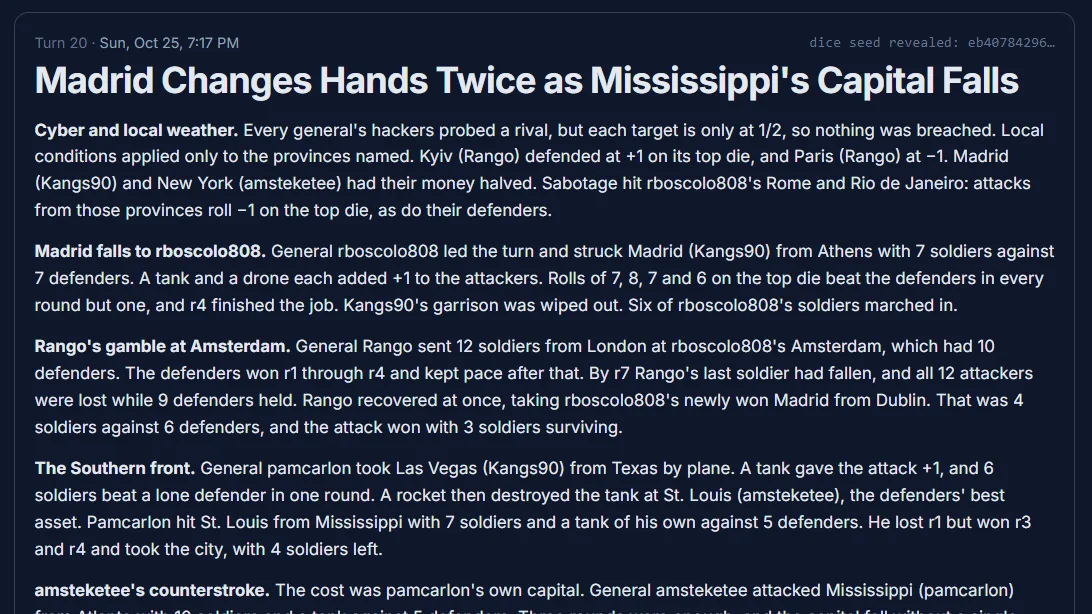
Combat Risk-style: the attacker rolls up to 3 dice (one per soldier still standing, one must stay home), the defender up to 2. Top die against top die, second against second — higher kills a soldier, ties favor the defender. Modifiers (tanks, drones, satellites, sabotage, event cards) adjust the top die for the whole assault — the ledger writes out the arithmetic (“6+2=8”), and the raw d6s are always recomputable from the revealed seed.
An assault rolls round after round until one side is finished: either every soldier you committed is lost, or the last defender falls and every survivor marches in. So the number you commit is the size of the occupying force, minus losses — and a bigger column can grind through a garrison in one night where a small one would break. The ledger shows each round compactly (“r1 6+1=7,4 vs 5,3 → att −1 def −1”) and then the result.
Units & assets Name 💰 / ⚡ Does Soldier 5 / 2 Fights. The only unit that moves, attacks, and holds ground. Cheap — mass them; your starting kit buys twenty. Diplomat 40 / 5 One influence push per turn, on a neutral province bordering the province it sits in. It never moves — recruit it where you want to push. More diplomats, more pushes. Spy 50 / 10 One sabotage per turn, anywhere on the board: attacks staged from the target roll −1, and so do its defenders. Politician 40 / 5 Politick the province they sit in: ×1.5 yields tonight. One per province — a second adds nothing. Scientist 60 / 20 Unlocks planes, satellites, rockets and missiles anywhere in your empire. One per province — a second elsewhere is only insurance against losing the first. Hacker 60 / 20 Lets you order a cyberattack from anywhere in your empire. One cyberattack per general per turn, however many hackers you keep, so one per province — a second elsewhere is only insurance against losing the first. Assassin 200 / 80 The dearest thing in the game. From the province it stands in, it goes for any province another general holds: its first attempt there infiltrates, the next kills one unit that is not a soldier (the one you name, else the most valuable) and the assassin is spent. One attempt per assassin a turn; it can act the turn after it is recruited. They stockpile. Name 💰 / ⚡ Does Drone 10 / 5 +1 to your top attack die. One drone is consumed per attack order — a stack arms multiple attacks, not one attack multiply. Tank 40 / 20 +1 to your top attack die. Permanent. Ship 50 / 20 Required to attack across a sea lane — the blue straits on the board (any border longer than 2,500 km). Plane 75 / 40 Attacks from its province reach two borders out, over land or sea. It flies, so a strait needs no ship. Needs a scientist. Satellite (defensive) 85 / 45 +1 to the top die of the defenders where it sits. Needs a scientist. Satellite (offensive) 85 / 45 +1 to the top die of every attack launched from where it sits. Needs a scientist. Rocket 100 / 50 Destroys the defender’s most valuable asset before the dice; holds fire (not consumed) if they have none. One rocket fires per attack order — three rockets feeding three attacks is a barrage. Needs a scientist. Missile 150 / 75 A rocket with range: fired on its own order at any province not yours within three borders, over land or sea, it destroys one asset there — the one you aim at if it still stands, else the most valuable. Holds fire (kept) when there is nothing to hit. Needs a scientist. Permanent assets don’t stack — one tank, ship, plane, defensive satellite and offensive satellite per province is all you need, and the builder won’t sell you a duplicate. So at most one satellite of each kind ever counts in a roll: +1 for the attack, +1 for the defense. Drones, rockets and missiles stockpile (one is spent per use).
Specialists don’t stack either — one politician, one scientist and one hacker per province, recruited one at a time. A politician works only its own province, one scientist unlocks planes, satellites, rockets and missiles for your whole empire, and a general gets one cyberattack a turn however many hackers stand behind it. A second elsewhere is insurance against losing the first. Soldiers, diplomats, spies and assassins come up to the week’s recruit cap an order, because every one of them adds a body or an action.
A cyberattack takes two. Your first on a general probes their network (the ledger says so, and the order form shows 1/2); the next one on the same general, this turn’s or later, breaches it and wipes one of their orders at random. With one cyberattack a turn, a breach on the same rival lands at most every other turn — except on a day a cyber event card is in play, drawn from a real cyberattack or an AI out of its sandbox, when every cyberattack counts double and one breaches.
An assassination takes two as well. An assassin’s first attempt on a province slips it inside (the ledger names the province it came from, and the province card shows the plot); the next attempt there kills and spends the assassin. Two assassins can do it in one turn, and so can one on a day an assassination event card is in play. The target’s answer is a turn to act: kill the assassin first (an assassin is a fair target, and the most valuable one there), or take the province it stands in. A province that changes hands loses every plot against it.
Playing the other games pays 3+ Where’s Marco clues found today → +20 money tonight. Found Marco himself → +1 soldier at your capital. Called today’s Bullshit fake → +10 energy tonight. The money and energy grow with income in later weeks (+30 and +15 in week 2).
Alerts Press Alerts at the top of a match page and Mappit will push a notification to your phone or computer when the table is waiting only on you, and when each turn rolls — email too, if you like. They cover every war you’re in, and nobody is alerted about a board they’re already looking at. On iPhone and iPad, add Mappit to your Home Screen first (Share, then Add to Home Screen) and turn alerts on from there: Apple only lets Home Screen apps receive pushes.
Table talk Every match has its own chat room — beside the board on desktop, its own tab on a phone. Seated generals post; anyone can read. Type @ to call out a general at the table (the mention notifies them). Marco posts a line at every checkpoint — seats taken, the war beginning, each turn’s standings and notable captures, resignations, final scores — and the whole conversation stays with the match record forever.
Leaving a game You can leave a waiting table any time (an emptied table is closed). In a live war, Resign (top of the match page) eliminates you: your provinces turn neutral with their garrisons standing, and if only one general remains, they win outright. A table waiting for players stays open until it fills, when the war starts on its own, or until any general seated there presses Start the war now with 2 or more in. The empty seats then close.
Information
- Status
- Released
- Release
- TBA
- Genre
- Art style
- Minimalist
- Platforms
- iOS, Android
- Price
- Freesubscription
- Players
- Multiplayer
- Age rating
- 12+
Tags
AI disclosure
AI is used in real-time during the game and is a significant part of the game play.
Discussion
Trailer & screenshots
About this game
The game Conquest is a Risk-style strategy game for 2–5 generals, played on the news. The board is the week’s most-covered news cities. Each general starts with a capital and two provinces beside it, then raises soldiers, agents and technology to take more: fighting for them, winning neutral ones over with diplomats, and sabotaging, hacking and assassinating rivals. The news is the weather: provinces whose storylines are trending pay more, and each day’s real events (a storm, a cyberattack, a truce) become cards that change the odds. Every turn all the generals order at once, the orders resolve together, and every roll is provably fair.
How you win Eliminate every rival for total conquest, or hold the most victory points when the war is scored (Friday night for a weekly war, the end of its weeks for an epic, its last turn for a blitz): 2 per province, 5 per enemy capital you hold, plus (money + energy) ÷ 20 at week-1 value — in later weeks the divisor grows with income (÷30 in week 2, ÷39 in week 3), so a hoard counts for what it would buy. Hoarding counts — but provinces count double. When the war ends, its dispatches open with the war in review: the whole war retold, and every general’s points with the arithmetic shown.
The map Every province is one of the week’s news cities, with its borders drawn around it; your match plays a connected slice of the week’s board, sized to the table. Provinces that share a border are neighbors: soldiers move and attack only between neighbors, except that a plane carries an attack two borders out (and a missile strikes up to three). A border longer than 2,500 km is a sea lane, one of the blue straits, and an attack across it needs a ship or a plane. Each province pays money and energy every turn, more when its city’s storyline is trending; select a province to see who holds it, its garrison and what it pays.
The board wraps east to west, like an old arcade map: the provinces on the far right border the ones on the far left, so no corner is a safe back wall. Drag the map any way you like — it never runs out — and it opens with you in the middle; center on me brings you back. Wars opened before the wrap arrived (late October 2026) keep the flat board and flat prices they began with.
Your start A capital (4 soldiers, 1 diplomat, 1 spy) plus two adjacent provinces (1 soldier each), 100 money and 40 energy. Lose all your provinces and you’re eliminated.
The week Every Saturday a new board is carved from the week’s most-covered news cities. A weekly match runs until Friday night’s final scoring — or until someone conquers everyone first. You can play in as many matches as you like; orders are per match.
The rhythm — weekly, epic or blitz Each turn you submit up to 5 orders in a war’s first week (more as the weeks pass — see Inflation), and submitting locks them in — no changes, and the table sees your checkmark. The moment every living general has reported, the turn resolves: all orders simultaneously, in fixed priority (world & local events → cyberattacks → assassinations → politick & sabotage → income → influence → build & buy → moves → missiles → attacks → outcome). Within a phase the seat holding the initiative acts first. Who holds it on turn 1 is drawn at random when the war starts, and it then rotates one seat around the table every turn, so no one keeps first strike. The ledger under each dispatch is laid out in exactly those phases, each header saying why it comes where it does. An eager table plays as many turns a day as it can. The dice come from a seed whose hash you can see before you order and whose value is revealed after — every roll is checkable.
A weekly match runs to Friday’s scoring (or ends early by total conquest), and each turn waits at most 24 hours: then it rolls without the generals who haven’t reported, who simply sit that turn out, so one absent general never freezes the war — and no table is rolled at midnight while half of it is asleep. A turn still waiting at Friday’s final never rolls; the war is scored as the map stands. An epic match runs for 1–4 weeks from launch — a long war lives through weeks of changing daily event cards, the news itself becoming its shifting weather — and has no clock: a turn rolls only when every living general is in, so a table spread across time zones plays every turn together. An absent general holds the table until they report or resign (or the general who opened the war calls it off), and when the weeks are up the war is scored as the map stands; a turn still waiting on someone never rolls. Having too much fun to stop? The general who opened a live weekly or epic war can extend it by 1–4 weeks from the match page (up to 12 weeks from launch). An extended weekly war becomes an epic, so from then on each turn waits for every general. A blitz match ignores the calendar and runs a chosen length — 7, 15 or 30 turns, or no limit, playing to total conquest — a whole campaign in one sitting. Same rules, same dice, same season credit.
The economy — news is the weather Each province you own pays its base money and energy every turn (select a province to see its rates), multiplied by its storyline’s heat today — a province whose news is trending pays up to ×2, a cold one pays base. Politicking adds ×1.5. Three daily event cards, drawn from real stories, shift the whole world: yield multipliers (×0.5–1.5), attack or defense die bonuses, doubled diplomacy, or — on a day a real cyberattack or an AI breaking out of its sandbox makes the news — doubled cyberattacks, so one breaches; and on a day an assassination, an attempt on someone’s life or a plot to kill makes the news, doubled assassinations, so one attempt kills.
On top of the global cards, LOCAL EVENTS strike individual provinces, drawn from that city’s own news: a wildfire cuts a province’s energy output, unrest costs its garrison a soldier, a fortification boosts its defenders, a storm wrecks an asset. They apply to that province only — whoever holds it — and they follow the news: when the wildfire ends or the truce is signed, the effect stops appearing. Dice and income effects hold all day; unit and asset changes happen once per day. The ledger names every one. Unrest can take a province’s last soldier: the province stays yours and keeps paying, but it stands empty — any attack takes it without a fight — until you move soldiers back in. The board marks an empty holding with a hollow 0.
The cards and the heat are the day’s weather, not the turn’s — real news doesn’t change by the hour, so every turn you play in a day fights under the same conditions. A fast table campaigns through one day’s world; a slow one watches it shift under their feet.
Inflation — every week dearer, and bigger Every seven turns is a week of the war — turns 1–7 are week 1, 8–14 week 2 — in every kind of war, whatever its pace: a table that plays three turns a day is in week 2 on its third day, one that plays a turn a day on its eighth. Each new week the routine gets dearer: soldiers cost 5, then 8, then 11, then 13 and 15. Cheap things follow prices fully; dear ones climb slower (a tank goes 40 → 55 → 65, a rocket 100 → 121 → 136), so tech gets relatively cheaper as a war grows old. The limits grow with them, and income too:
Week (turns) Soldier Recruits an order Orders a turn Income 1 (1–7) 5 / 2 5 5 ×1 2 (8–14) 8 / 3 9 7 ×1.52 3 (15–21) 11 / 4 13 9 ×1.93 4 (22–28) 13 / 5 16 10 ×2.3 5 (29–35) 15 / 6 20 11 ×2.63 Orders top out at 12 a turn from week 6, recruits at 30 an order. A turn keeps its week’s prices from the first order to the dice, and Marco tells the table talk when a new week opens. Income trails the price of soldiers on purpose: coin hoarded in week 1 buys less in week 3, so spend it while it is worth something. The order form always shows this week’s prices, and the strip above the board shows next week’s and the turn they arrive on.
Orders move — Shift soldiers between two adjacent provinces you own. One soldier always stays behind as garrison. Only soldiers move — every other unit stays where it was recruited.
attack — Send soldiers at an adjacent enemy or neutral province, or from a province with a plane at one up to two borders out. Sea lanes need a ship (or that plane). The assault rolls round after round until your column is spent or the last defender falls — then every survivor marches in.
missile — Fire a missile from a province holding one at any province not yours up to three borders away, land or sea alike, and name the asset to destroy (or leave it to hit the most valuable). Missiles land after the moves and before the attacks, so tonight’s assaults face what is left. A missile bought in the same night’s orders can fire that night.
influence — A diplomat in one of your provinces bordering the target pushes it — one push per diplomat per turn. Neutral provinces flip at 2 influence — two pushes, or one under a diplomacy event card.
spy — Sabotage an enemy or neutral province: tonight every attack staged from it rolls −1 on its top die, and its defenders roll −1 when attacked. One sabotage per spy per turn, from anywhere in your empire — mark the province you mean to hit, or the one they will strike from.
cyber — Pick a rival general, not a province. Two cyberattacks on the same general breach them, like two diplomatic pushes (one does, under a cyber event card): the first probes their network (the ledger says so), and the next — this turn’s or a later one’s — wipes one of their orders at random before anything else resolves, and it never happens. Needs a hacker anywhere in your empire; one cyberattack per general per turn, and it never wipes their own cyberattack.
assassinate — Send an assassin from the province it stands in into any province another general holds, and name the unit it goes for (or leave it to take the most valuable there: an assassin, a scientist, a hacker, a spy, a diplomat, a politician — never soldiers). It takes two, like two diplomatic pushes: the first attempt on a province infiltrates (the ledger tells the table), and the next one there — this turn’s from a second assassin, or a later turn’s — kills, and that assassin is spent. Under an assassination event card one attempt kills. With nobody there but soldiers the assassin waits inside and is kept. A province that changes hands loses every plot against it.
build — Recruit a unit in a province you own — up to the week’s recruit cap of soldiers, diplomats, spies or assassins in a single order (five in week 1). Politicians, scientists and hackers come one at a time, one per province.
buy — Buy one asset in a province you own.
politick — A politician you own in that province works the crowd: ×1.5 money and energy from it tonight. One politick per province per turn.
Combat Risk-style: the attacker rolls up to 3 dice (one per soldier still standing, one must stay home), the defender up to 2. Top die against top die, second against second — higher kills a soldier, ties favor the defender. Modifiers (tanks, drones, satellites, sabotage, event cards) adjust the top die for the whole assault — the ledger writes out the arithmetic (“6+2=8”), and the raw d6s are always recomputable from the revealed seed.
An assault rolls round after round until one side is finished: either every soldier you committed is lost, or the last defender falls and every survivor marches in. So the number you commit is the size of the occupying force, minus losses — and a bigger column can grind through a garrison in one night where a small one would break. The ledger shows each round compactly (“r1 6+1=7,4 vs 5,3 → att −1 def −1”) and then the result.
Units & assets Name 💰 / ⚡ Does Soldier 5 / 2 Fights. The only unit that moves, attacks, and holds ground. Cheap — mass them; your starting kit buys twenty. Diplomat 40 / 5 One influence push per turn, on a neutral province bordering the province it sits in. It never moves — recruit it where you want to push. More diplomats, more pushes. Spy 50 / 10 One sabotage per turn, anywhere on the board: attacks staged from the target roll −1, and so do its defenders. Politician 40 / 5 Politick the province they sit in: ×1.5 yields tonight. One per province — a second adds nothing. Scientist 60 / 20 Unlocks planes, satellites, rockets and missiles anywhere in your empire. One per province — a second elsewhere is only insurance against losing the first. Hacker 60 / 20 Lets you order a cyberattack from anywhere in your empire. One cyberattack per general per turn, however many hackers you keep, so one per province — a second elsewhere is only insurance against losing the first. Assassin 200 / 80 The dearest thing in the game. From the province it stands in, it goes for any province another general holds: its first attempt there infiltrates, the next kills one unit that is not a soldier (the one you name, else the most valuable) and the assassin is spent. One attempt per assassin a turn; it can act the turn after it is recruited. They stockpile. Name 💰 / ⚡ Does Drone 10 / 5 +1 to your top attack die. One drone is consumed per attack order — a stack arms multiple attacks, not one attack multiply. Tank 40 / 20 +1 to your top attack die. Permanent. Ship 50 / 20 Required to attack across a sea lane — the blue straits on the board (any border longer than 2,500 km). Plane 75 / 40 Attacks from its province reach two borders out, over land or sea. It flies, so a strait needs no ship. Needs a scientist. Satellite (defensive) 85 / 45 +1 to the top die of the defenders where it sits. Needs a scientist. Satellite (offensive) 85 / 45 +1 to the top die of every attack launched from where it sits. Needs a scientist. Rocket 100 / 50 Destroys the defender’s most valuable asset before the dice; holds fire (not consumed) if they have none. One rocket fires per attack order — three rockets feeding three attacks is a barrage. Needs a scientist. Missile 150 / 75 A rocket with range: fired on its own order at any province not yours within three borders, over land or sea, it destroys one asset there — the one you aim at if it still stands, else the most valuable. Holds fire (kept) when there is nothing to hit. Needs a scientist. Permanent assets don’t stack — one tank, ship, plane, defensive satellite and offensive satellite per province is all you need, and the builder won’t sell you a duplicate. So at most one satellite of each kind ever counts in a roll: +1 for the attack, +1 for the defense. Drones, rockets and missiles stockpile (one is spent per use).
Specialists don’t stack either — one politician, one scientist and one hacker per province, recruited one at a time. A politician works only its own province, one scientist unlocks planes, satellites, rockets and missiles for your whole empire, and a general gets one cyberattack a turn however many hackers stand behind it. A second elsewhere is insurance against losing the first. Soldiers, diplomats, spies and assassins come up to the week’s recruit cap an order, because every one of them adds a body or an action.
A cyberattack takes two. Your first on a general probes their network (the ledger says so, and the order form shows 1/2); the next one on the same general, this turn’s or later, breaches it and wipes one of their orders at random. With one cyberattack a turn, a breach on the same rival lands at most every other turn — except on a day a cyber event card is in play, drawn from a real cyberattack or an AI out of its sandbox, when every cyberattack counts double and one breaches.
An assassination takes two as well. An assassin’s first attempt on a province slips it inside (the ledger names the province it came from, and the province card shows the plot); the next attempt there kills and spends the assassin. Two assassins can do it in one turn, and so can one on a day an assassination event card is in play. The target’s answer is a turn to act: kill the assassin first (an assassin is a fair target, and the most valuable one there), or take the province it stands in. A province that changes hands loses every plot against it.
Playing the other games pays 3+ Where’s Marco clues found today → +20 money tonight. Found Marco himself → +1 soldier at your capital. Called today’s Bullshit fake → +10 energy tonight. The money and energy grow with income in later weeks (+30 and +15 in week 2).
Alerts Press Alerts at the top of a match page and Mappit will push a notification to your phone or computer when the table is waiting only on you, and when each turn rolls — email too, if you like. They cover every war you’re in, and nobody is alerted about a board they’re already looking at. On iPhone and iPad, add Mappit to your Home Screen first (Share, then Add to Home Screen) and turn alerts on from there: Apple only lets Home Screen apps receive pushes.
Table talk Every match has its own chat room — beside the board on desktop, its own tab on a phone. Seated generals post; anyone can read. Type @ to call out a general at the table (the mention notifies them). Marco posts a line at every checkpoint — seats taken, the war beginning, each turn’s standings and notable captures, resignations, final scores — and the whole conversation stays with the match record forever.
Leaving a game You can leave a waiting table any time (an emptied table is closed). In a live war, Resign (top of the match page) eliminates you: your provinces turn neutral with their garrisons standing, and if only one general remains, they win outright. A table waiting for players stays open until it fills, when the war starts on its own, or until any general seated there presses Start the war now with 2 or more in. The empty seats then close.
Information
- Status
- Released
- Release
- TBA
- Genre
- Art style
- Minimalist
- Platforms
- iOS, Android
- Price
- Freesubscription
- Players
- Multiplayer
- Age rating
- 12+
Tags
AI disclosure
AI is used in real-time during the game and is a significant part of the game play.