Space Trade Company
Media Assets

Game Description
About the Game
Space Trade Company is a turn-based strategy game about building a powerful interplanetary corporation through deck-building, resource management, base expansion, research, contracts, and ruthless competition. Develop your company, seize opportunities before your rivals do, and survive the disasters they throw your way.
The game draws inspiration from modern board games and classic computer strategy games such as Dune: Imperium, Through the Ages, and Sid Meier's Colonization. At its core, the game is about building and adapting your strategy as the situation changes. Develop your deck, carefully choose which cards to play, expand your base, research new technologies, complete missions, and compete for lucrative contracts.
Resources are limited and opportunities can disappear quickly. Success depends on knowing when to invest, when to expand, when to hold back, and when to interfere with your competitors. Contracts are not simply awarded to the most efficient company. Players may need to complete missions, build influence, and even use bribery to secure valuable deals before their rivals do. Competition can also become far less civilized. Cards and special effects can trigger disasters that disrupt your opponents' workers, production, resources, and plans. At the same time, you must be ready to deal with the disasters they trigger against you.
Space Trade Company is designed for high replayability. Players can choose from 18 different companies, each with unique abilities and cards, while a pool of more than 100 cards allows decks and strategies to develop differently from game to game. The objective is simple: build the most successful space-trading company and earn more victory points than your competitors. How you get there is up to you.
To keep matches moving, all players take their turns simultaneously, reducing downtime. An optional turn timer can also be used to keep the game flowing. If a human player leaves an online match, other than the host, that player is automatically replaced by an AI opponent so the match can continue
What Makes It Different?
Space Trade Company combines the structure of a strategy board game with deck-building, base development, resource management, and direct player interaction.
Players are not simply building their own economy in isolation. They are constantly competing for the same opportunities, missions, contracts, and resources while using cards and special effects to interfere with each other.
With 18 companies, more than 100 cards, research abilities, contracts, missions, disasters, and changing economic conditions, players must adapt rather than follow the same strategy every game.
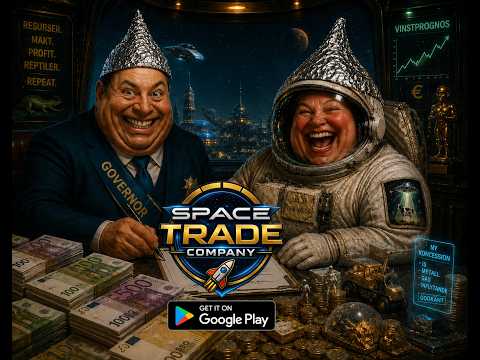
Its darkly humorous corporate setting also gives the game a distinctive tone: ruthless companies explore distant planets, exploit resources, bribe officials, compete for contracts, and occasionally make life considerably more difficult for their competitors.
Key Features
- Turn-based strategy with simultaneous turns - players act at the same time, greatly reducing downtime.
- Deck-building and card management - build and adapt your deck from a pool of more than 100 cards.
- Resource and economic management - produce, trade, invest, and decide how best to use limited resources.
- Build and develop your space base - expand production and create an engine that supports your strategy.
- 18 unique companies - each company offers different abilities, cards, and strategic possibilities.
- Highly interactive competition - compete for missions and contracts while directly disrupting opponents.
- Research, exploration, contracts, bribery, and disasters - multiple interconnected systems create different paths to victory.
- Single-player, local, and online play - play against AI or human opponents, with AI able to replace dropped online players.
Gameplay
A game of Space Trade Company is played over 25 turns. Each turn consists of an Action Phase followed by an End-of-Turn Resolution Phase.
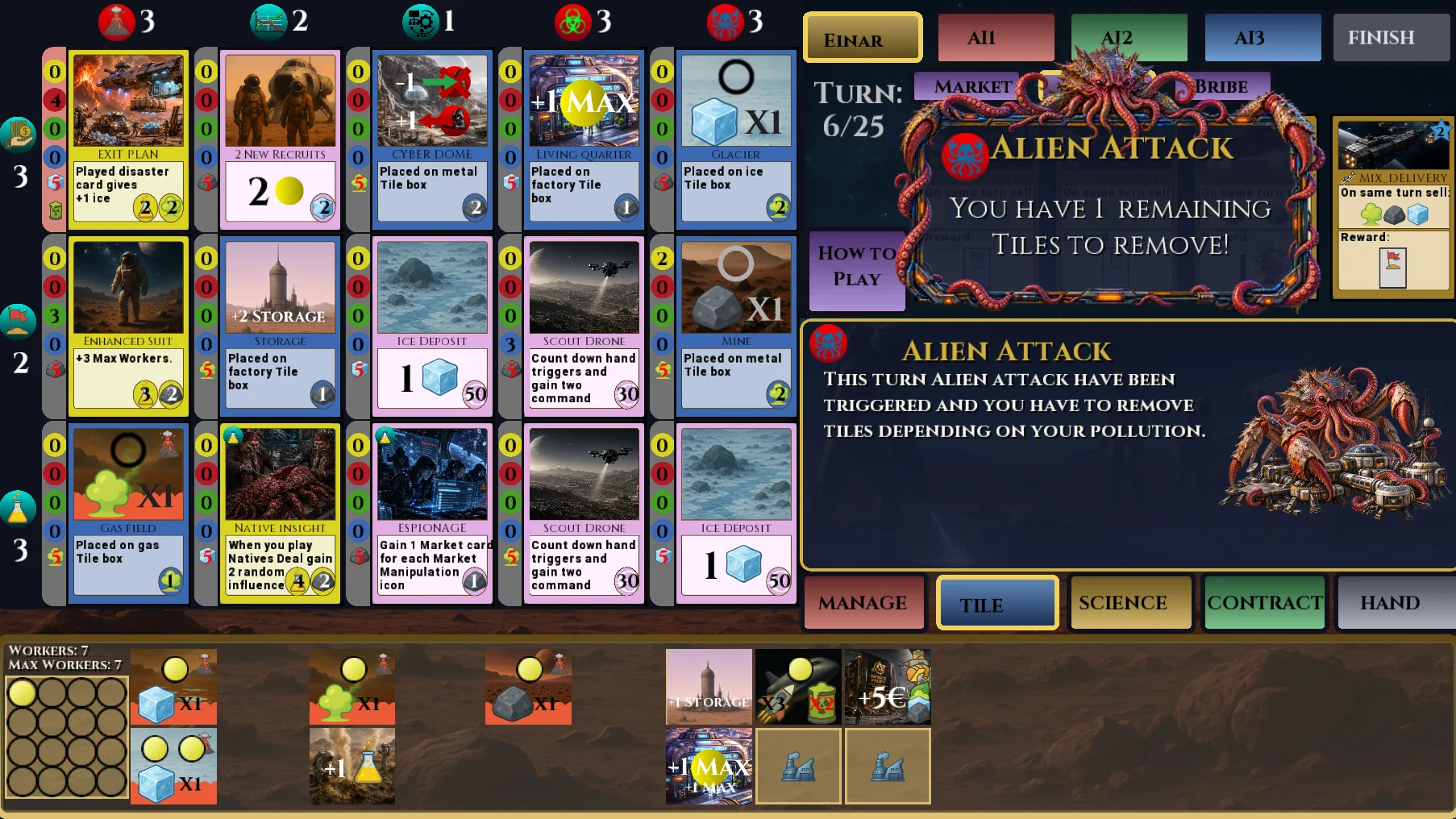
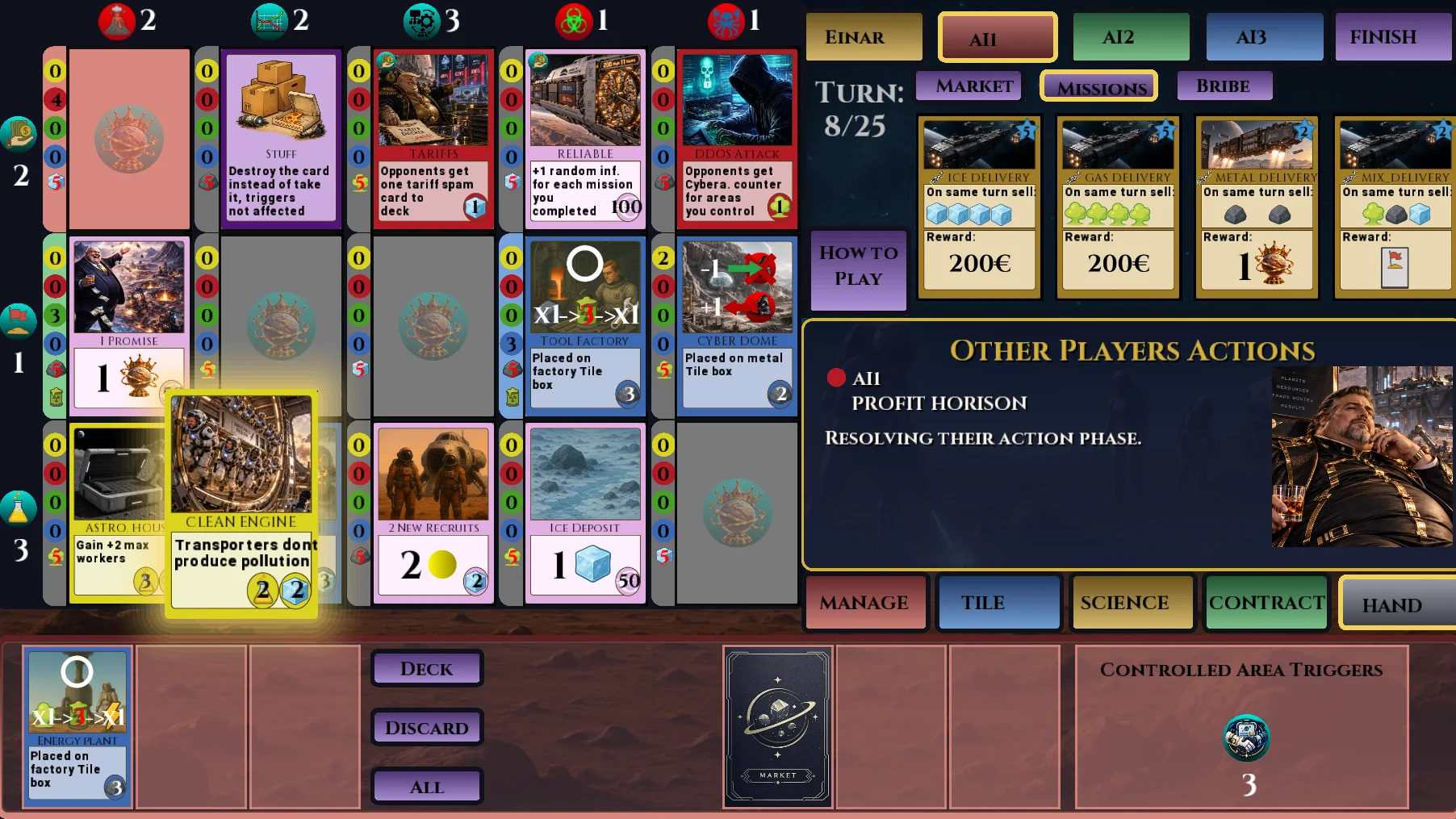
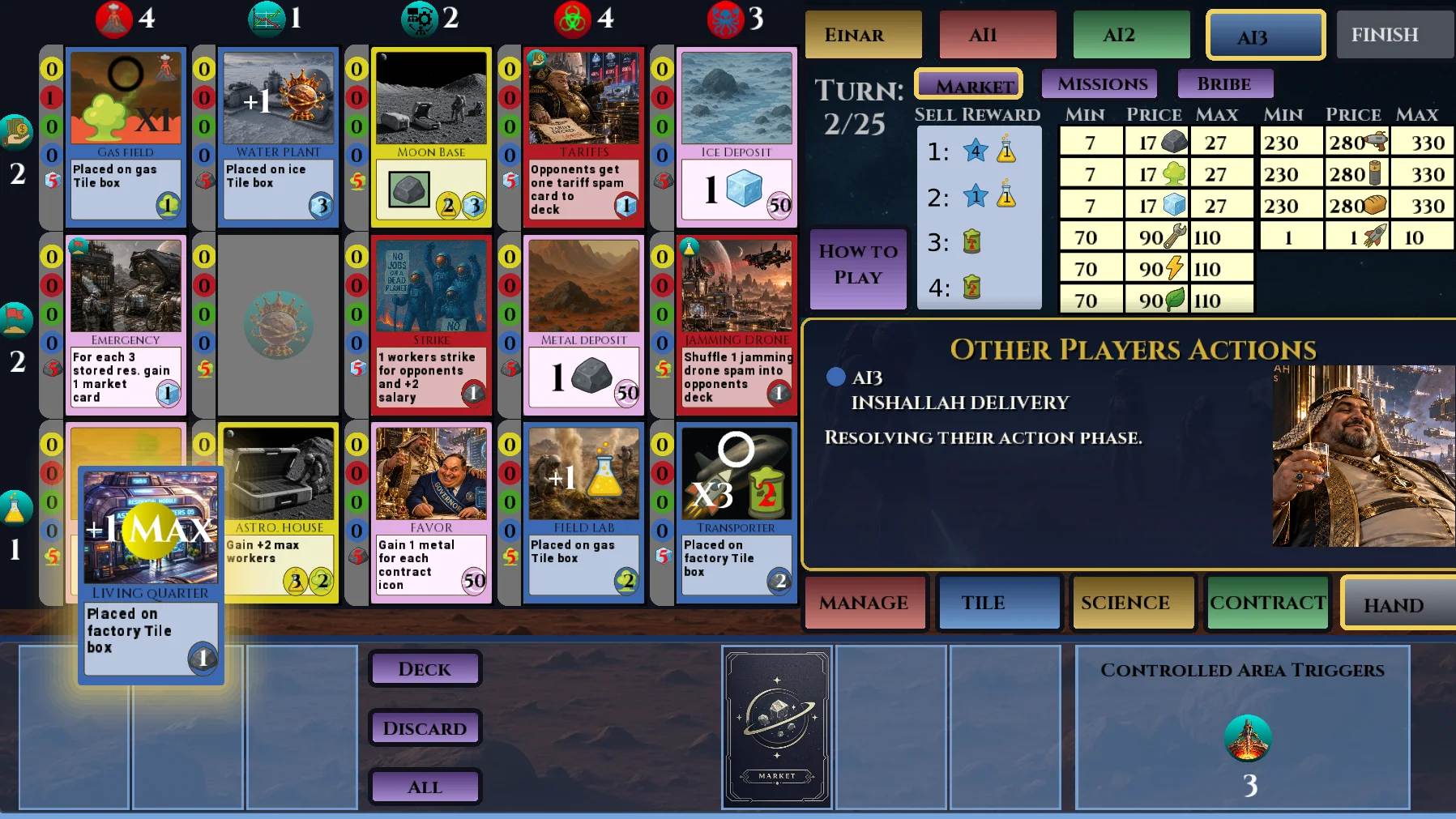
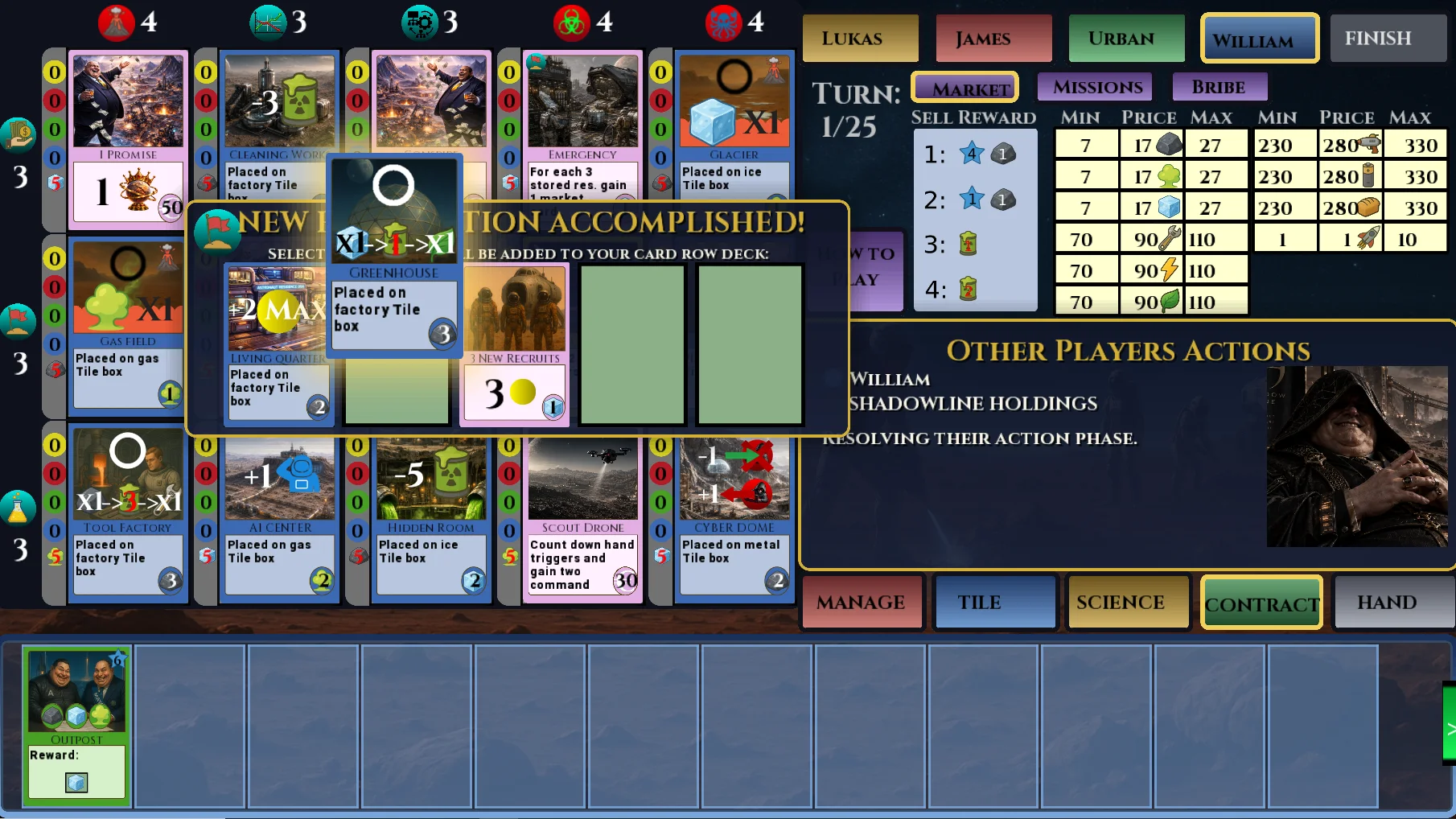
During the Action Phase, players spend action points to take cards from their card row into their hand and then play those cards to develop their company. Cards can be used to expand a player's base, improve production, explore for new opportunities, research unique abilities, generate resources, and interfere with opponents.
Exploration Exploration allows players to discover new advanced cards. Selected cards become available to the player and can gradually become part of their developing deck and strategy.
Research Science cards and research allow players to unlock unique abilities and create new strategic possibilities for their company.
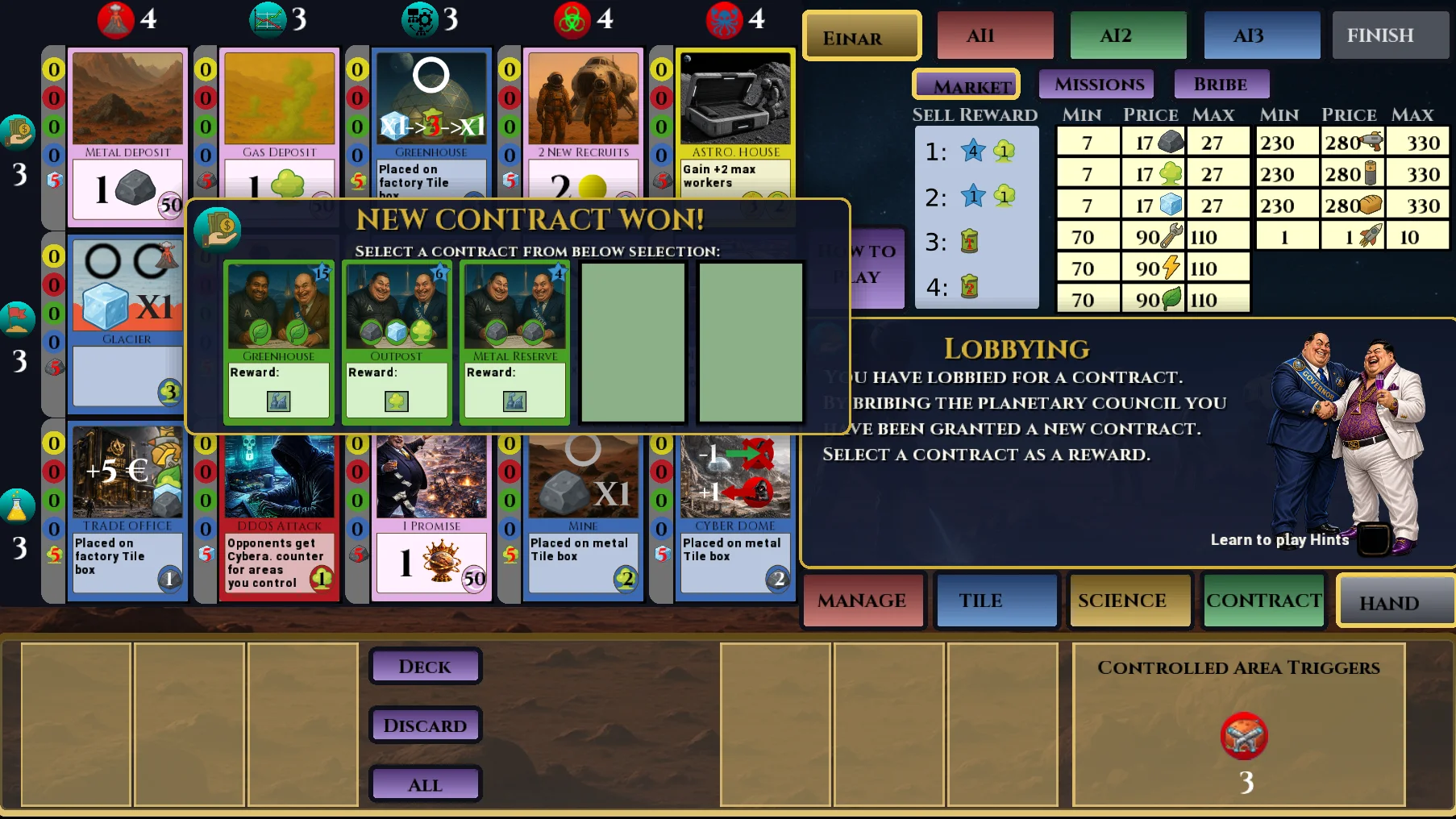
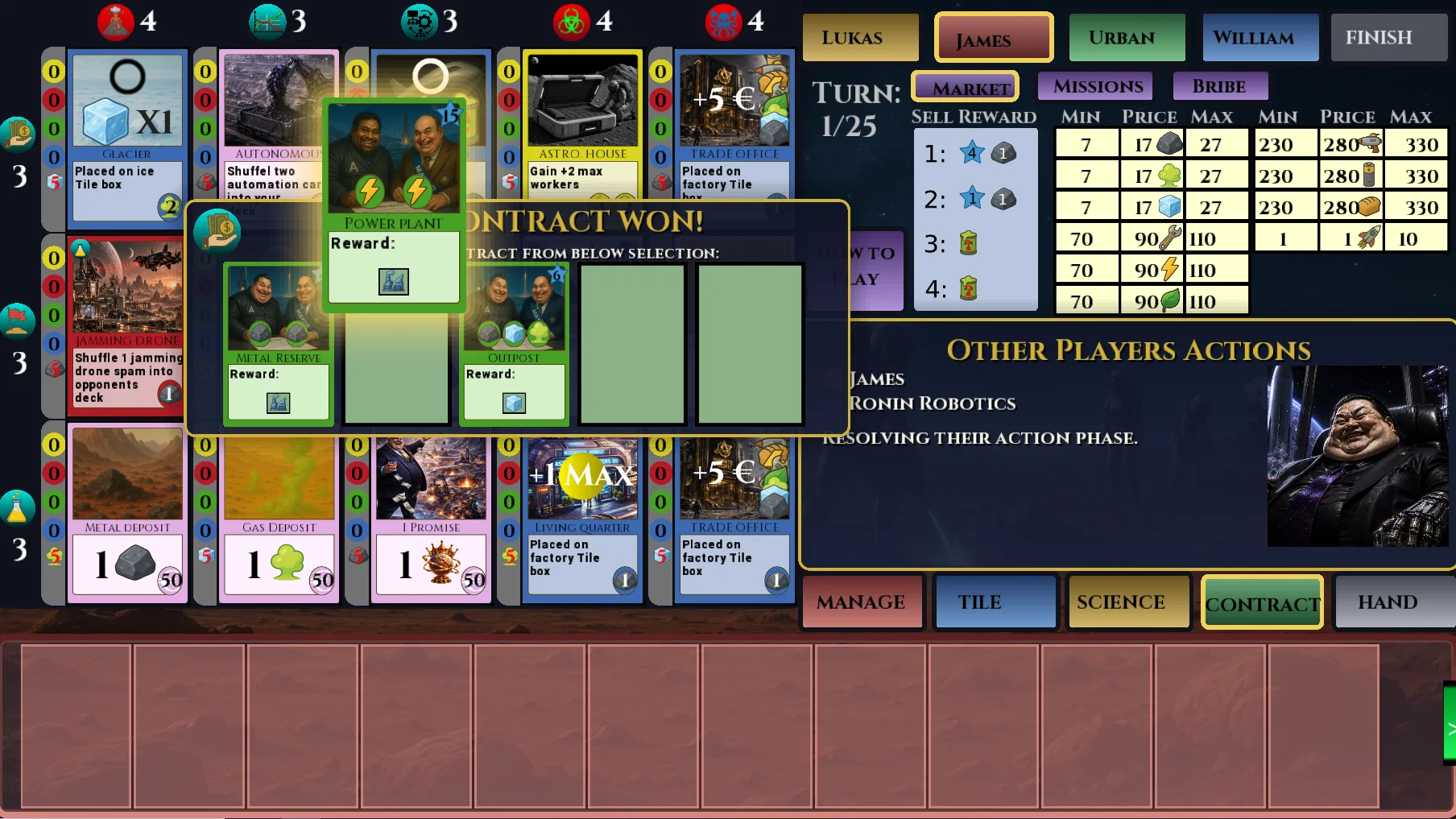
Missions and Contracts Players use resources and other requirements to complete missions and compete for valuable contracts. Contracts can provide significant rewards, but competitors may be working toward the same objective. Players therefore need to judge when to spend resources, when to wait, and when to move before an opponent takes the opportunity. Influence and bribery can also play a role in securing contracts.
Disasters & End-of-Turn Resolution
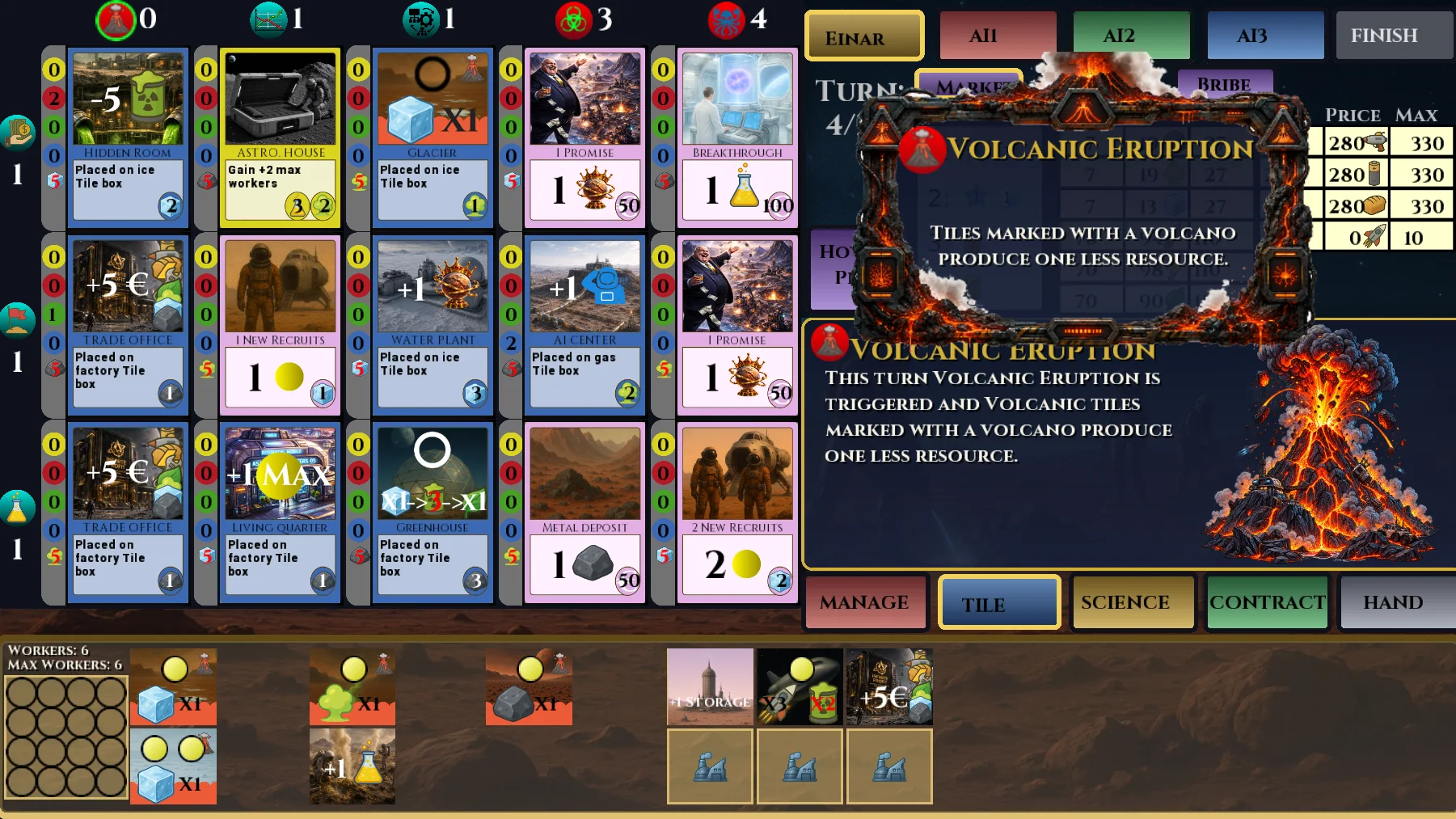
Players can use cards and effects to create problems for their competitors. Disasters can interfere with workers, production, resources, and other parts of an opponent's strategy. This creates a game where players must constantly pay attention to what their rivals are doing rather than simply optimizing their own company.
At the end of each turn, triggered effects and disasters are resolved. Players must deal with the consequences of effects triggered during the turn, including problems created by competing companies. This creates an ongoing cycle of planning, expansion, competition, disruption, and recovery.
Theme
Space • Trade • Greed • Corporate rivalry • Dark humor • Futuristic science fiction
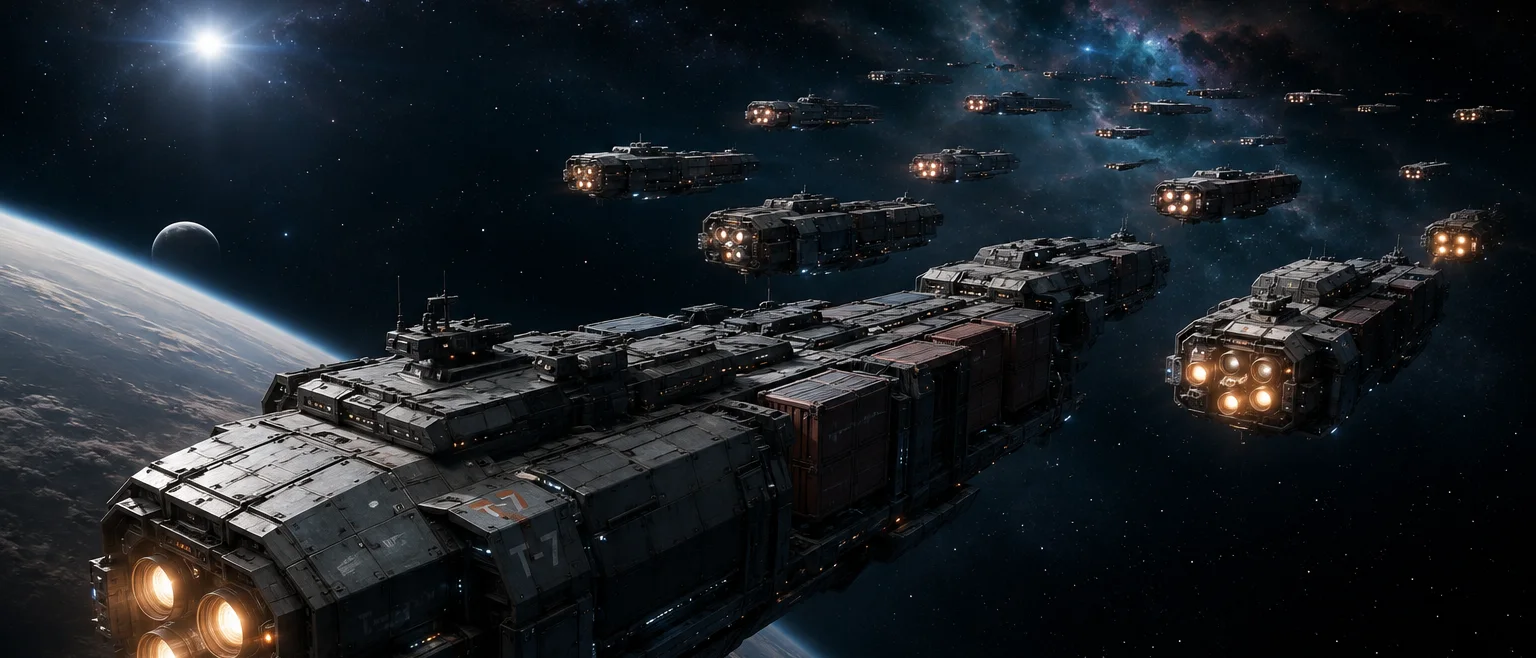
The game presents a future where distant planets offer enormous economic opportunities - and corporations are willing to do almost anything to take advantage of them. Players compete for resources, expand industrial operations, manipulate contracts, research new technology, bribe their way toward opportunities, and sabotage their competitors while trying to present themselves as the most successful company in space
Tags
Socials
AI Disclosure
Discussion
Badges
Media Assets
Game Description
About the Game
Space Trade Company is a turn-based strategy game about building a powerful interplanetary corporation through deck-building, resource management, base expansion, research, contracts, and ruthless competition. Develop your company, seize opportunities before your rivals do, and survive the disasters they throw your way.
The game draws inspiration from modern board games and classic computer strategy games such as Dune: Imperium, Through the Ages, and Sid Meier's Colonization. At its core, the game is about building and adapting your strategy as the situation changes. Develop your deck, carefully choose which cards to play, expand your base, research new technologies, complete missions, and compete for lucrative contracts.
Resources are limited and opportunities can disappear quickly. Success depends on knowing when to invest, when to expand, when to hold back, and when to interfere with your competitors. Contracts are not simply awarded to the most efficient company. Players may need to complete missions, build influence, and even use bribery to secure valuable deals before their rivals do. Competition can also become far less civilized. Cards and special effects can trigger disasters that disrupt your opponents' workers, production, resources, and plans. At the same time, you must be ready to deal with the disasters they trigger against you.
Space Trade Company is designed for high replayability. Players can choose from 18 different companies, each with unique abilities and cards, while a pool of more than 100 cards allows decks and strategies to develop differently from game to game. The objective is simple: build the most successful space-trading company and earn more victory points than your competitors. How you get there is up to you.
To keep matches moving, all players take their turns simultaneously, reducing downtime. An optional turn timer can also be used to keep the game flowing. If a human player leaves an online match, other than the host, that player is automatically replaced by an AI opponent so the match can continue
What Makes It Different?
Space Trade Company combines the structure of a strategy board game with deck-building, base development, resource management, and direct player interaction.
Players are not simply building their own economy in isolation. They are constantly competing for the same opportunities, missions, contracts, and resources while using cards and special effects to interfere with each other.
With 18 companies, more than 100 cards, research abilities, contracts, missions, disasters, and changing economic conditions, players must adapt rather than follow the same strategy every game.
Its darkly humorous corporate setting also gives the game a distinctive tone: ruthless companies explore distant planets, exploit resources, bribe officials, compete for contracts, and occasionally make life considerably more difficult for their competitors.
Key Features
- Turn-based strategy with simultaneous turns - players act at the same time, greatly reducing downtime.
- Deck-building and card management - build and adapt your deck from a pool of more than 100 cards.
- Resource and economic management - produce, trade, invest, and decide how best to use limited resources.
- Build and develop your space base - expand production and create an engine that supports your strategy.
- 18 unique companies - each company offers different abilities, cards, and strategic possibilities.
- Highly interactive competition - compete for missions and contracts while directly disrupting opponents.
- Research, exploration, contracts, bribery, and disasters - multiple interconnected systems create different paths to victory.
- Single-player, local, and online play - play against AI or human opponents, with AI able to replace dropped online players.
Gameplay
A game of Space Trade Company is played over 25 turns. Each turn consists of an Action Phase followed by an End-of-Turn Resolution Phase.
During the Action Phase, players spend action points to take cards from their card row into their hand and then play those cards to develop their company. Cards can be used to expand a player's base, improve production, explore for new opportunities, research unique abilities, generate resources, and interfere with opponents.
Exploration Exploration allows players to discover new advanced cards. Selected cards become available to the player and can gradually become part of their developing deck and strategy.
Research Science cards and research allow players to unlock unique abilities and create new strategic possibilities for their company.
Missions and Contracts Players use resources and other requirements to complete missions and compete for valuable contracts. Contracts can provide significant rewards, but competitors may be working toward the same objective. Players therefore need to judge when to spend resources, when to wait, and when to move before an opponent takes the opportunity. Influence and bribery can also play a role in securing contracts.
Disasters & End-of-Turn Resolution
Players can use cards and effects to create problems for their competitors. Disasters can interfere with workers, production, resources, and other parts of an opponent's strategy. This creates a game where players must constantly pay attention to what their rivals are doing rather than simply optimizing their own company.
At the end of each turn, triggered effects and disasters are resolved. Players must deal with the consequences of effects triggered during the turn, including problems created by competing companies. This creates an ongoing cycle of planning, expansion, competition, disruption, and recovery.
Theme
Space • Trade • Greed • Corporate rivalry • Dark humor • Futuristic science fiction
The game presents a future where distant planets offer enormous economic opportunities - and corporations are willing to do almost anything to take advantage of them. Players compete for resources, expand industrial operations, manipulate contracts, research new technology, bribe their way toward opportunities, and sabotage their competitors while trying to present themselves as the most successful company in space